

How To Draw Backgrounds Step By Step
Desire tips to drawing backgrounds of your artwork like a pro? Saying yes? No worries, only read this mail till the end as this mail service says it all!
At that place are a lot of things that artists can draw.
For instance, artists can draw a house, a landscape, mountains, fruits, a cityscape, galaxy, or a portrait.
Do you know i thing that all artists depict in their drawings or sketches?
The respond is simple: Cartoon Backgrounds!
Aye, information technology is right! Cartoon the backgrounds of a painting is ane of the biggest yet important parts of an artwork that nigh every artist must exercise.
Today I will show you lot how you tin draw a groundwork similar a pro.
One thing that you must proceed in mind is that you lot should brand the groundwork of your cartoon elementary but brand it colorful as well.
Considering if you draw unproblematic backgrounds, the epitome that yous have drawn will go the focus of your drawing.
It does not hateful that you should pay less attending to the backgrounds.
When yous're drawing uncomplicated backgrounds, you'll desire to learn some tips on how to draw one point perspective or two betoken perspective.
Why drawing backgrounds is important
Think, backgrounds are very important in drawings.
They are an essential office of the compositions.
And they have a major role to make or break your piece of art.
Fifty-fifty if you, equally an artist, have left the infinite empty or white in the background, information technology means that you are even so creating the background – a white background.
So, whatever the background of a cartoon is, information technology has a huge impact on the terminal artwork – whether the touch on is good or bad!
Once you have learned to draw objects, people, or characters in dynamic poses, information technology is time to begin drawing backgrounds.
It is important to use those colors in the background that friction match the primary paradigm.
If yous have created all positive shapes in an image, then the negative shapes will represent the background.
This post highlights everything that you lot demand to know virtually cartoon backgrounds.
Here, you lot will come up to know some basic and advanced tips by which you can depict backgrounds of your drawings and paintings like a pro.
We will show yous how you lot can draw some basic shapes also as lines.
By reading this post till the end, you will too become to know calculation patterns in the backgrounds to add together a visual appeal to your drawing.
Are you lot set to detect some tips for backgrounds? Let's take a offset at present!
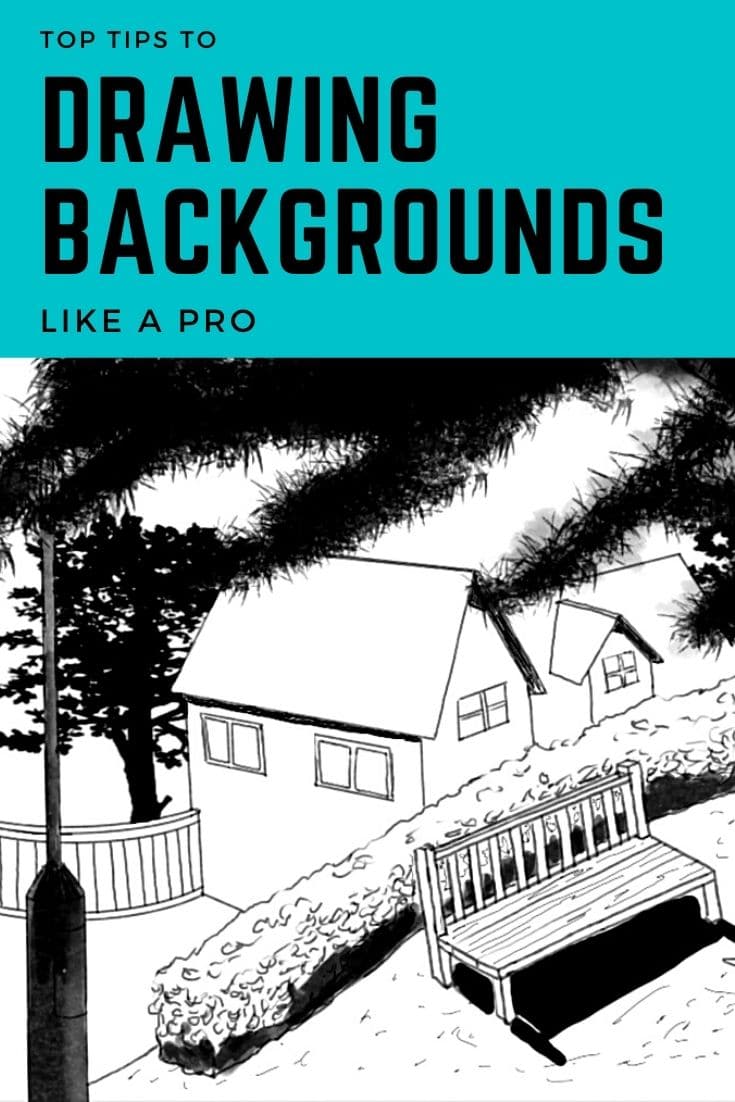
Utilise low-cal colors in the groundwork so it can complement with the main elements
The first and foremost tip that may help yous in drawing the background of your artwork is using low-cal colors.
When patently backgrounds are not used, obviously some colors are added in the background to make them look appealing.
Such colors should be added in the background that can complement the primary object of the drawing rather than competing with it.
Let'due south say you are drawing a landscape where there are brown rocks in the front and at the dorsum, at that place are big mountains.
The upper portion of the painting is filled with sky.
As the rocks in the front are the focal points and are dark brown in shade, for coloring the background (including mountains and sky), you lot need to add colors mixed with white.
For example, for the heaven, you can add lite blue color and for mountains, y'all can add together the same brown shade that was used for the foreground rocks just this fourth dimension, the colour is mixed with white to add together a light effect to the background.
What you have learned: Never add such colors in the background that competes with the focal signal for the attention of the viewer!
Avoid long straight or curved lines when drawing backgrounds
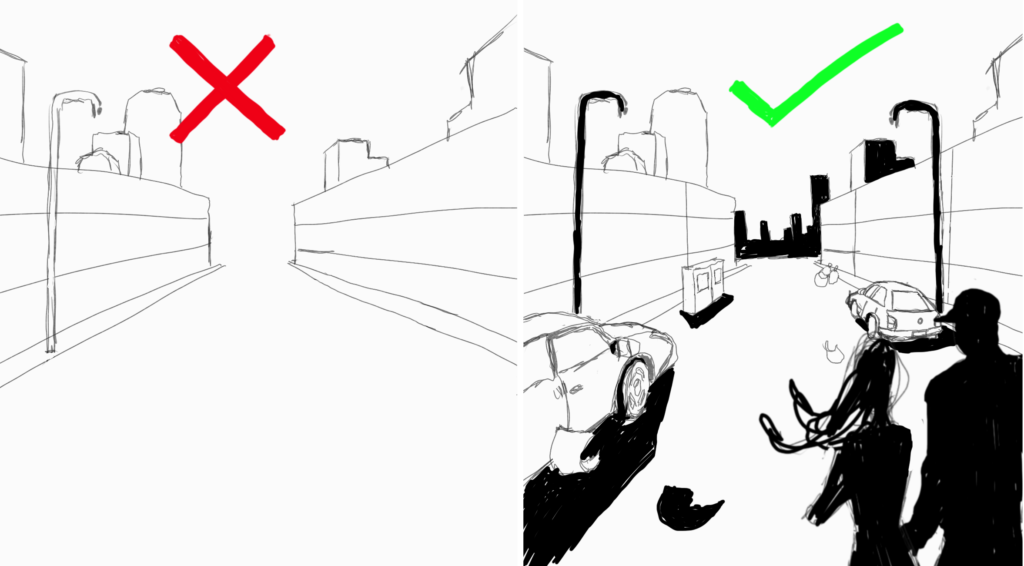
The next important tip is to avert long straight and curved lines.
At present you must be thinking lines are everywhere in the drawings and so how you can avoid them.
Let me tell you.
You tin definitely use long directly and curved lines but there should be some object that breaks into them.
In other words, I can say that they should be asunder.
Why?
Because if there are long lines in the background, the whole artwork may become boring or inartistic.
Consider this by taking an instance of arranging a room.
To ready a room, you volition put diverse pieces of furniture, wall hangings, or carpets merely to fill the blank infinite and long lines.
The same is the example with drawing the backgrounds.
If at that place is monotony in the groundwork using long straight and curved lines, you lot should break information technology otherwise the viewer will non exist attracted to the whole artwork.
Therefore, to make your backgrounds interesting, you should avoid using long lines.
What you have learned: For making the background of your paintings appealing, interesting and not disturbing to the centre, never depict long lines, either straight or curved.
The lines must be cleaved by some objects.
Never use a evidently paper background for complex compositions
Want another tip for drawing backgrounds?
Never use a plain paper background for complex compositions.
A manifestly paper background means that you have not drawn a background because the color of the paper serves as a background.
This type of background is easy considering you just demand to select the right color of paper that y'all may utilise equally a background.
BUT a plainly paper background does non work well for complex compositions.
If the subject is complex, a obviously newspaper background volition make the subject slow and boring instead of making it interesting to look at.
That existence said, a patently paper background can work well if you are working on a still life painting or drawing a simple portrait.
What you have learned: For unproblematic portraits and however life paintings, using a plain paper background is adept merely for complex art compositions, never use a manifestly background.
Parallel lines in the background should not conflict with one another

For designing the background of a drawing, another technique is near parallel lines.
To brand a background add together a positive vibe to the subject area, you can draw parallel lines in the groundwork only they should not conflict with 1 some other.
Let'south take an example of a background of a room.
In such a cartoon, you need to show the interior of the room such as a sofa, flower vase, clock, wall hanging, or a tabular array.
If you grouping the furniture or other interior items of the room in such a way that the lines are becoming parallel, what will it show?
Can we call information technology a good composition?
Absolutely non!
The parallel lines are conflicting with ane some other.
They should be broken past other objects.
For example, if you have drawn a drape then its parallel line should not lucifer with that of the sofa (placed just beside the curtain).
What you take learned: If the background of your artwork contains many parallel lines, make sure that they are not conflicting with each other.
Always effort to brand them with some objects!
Draw a groundwork that unifies the whole artwork
Information technology is some other technique that an artist must follow if he/she is drawing backgrounds.
You should draw such a groundwork that unifies the whole image.
This tip for cartoon the backgrounds is typically related to the colors.
It means that the colors of the background should be such that they tin complement the colors of the main object.
For example, consider a drawing in which there is a bird sitting on the branch of a tree.
Now the question arises hither is what will be the background?
Volition it be a plain background or should an artist use light colors?
Information technology totally depends on the colors that are used in the bird and the co-operative of a tree.
If the bird has xanthous and black color and the flowers on a tree branch have pink colors, then you lot can use yellow and pink colors in the background.
But instead of making them likewise bright, effort to make colors diffused then that the viewer can focus on the actual discipline of the image and that is a bird.
What you have learned: An artist can use different colors in the background. Simply such colors should be used that can unify the whole piece of art.
Use a tinted groundwork to soften the hardness of a patently background
If you have used a plain background just want to soften its hardness at the same time, you can utilise a tinted background.
Basically, a tinted groundwork is besides a plain background but you lot can add some shades of colors or pencils in the selected areas, maybe in the corner of the painting or at the edges of the main subject.
The tinted groundwork helps a lot in making the subject to focus the attending of the viewer.
But ane thing that should be kept in listen is that such colors should be used for a tinted background that matches the colors used in the subject.
What you accept learned: If you lot do not want to use a patently background but brand the background simple as well, you can use a tinted groundwork past shading in some areas of the background.
Use elements in the background to create depth
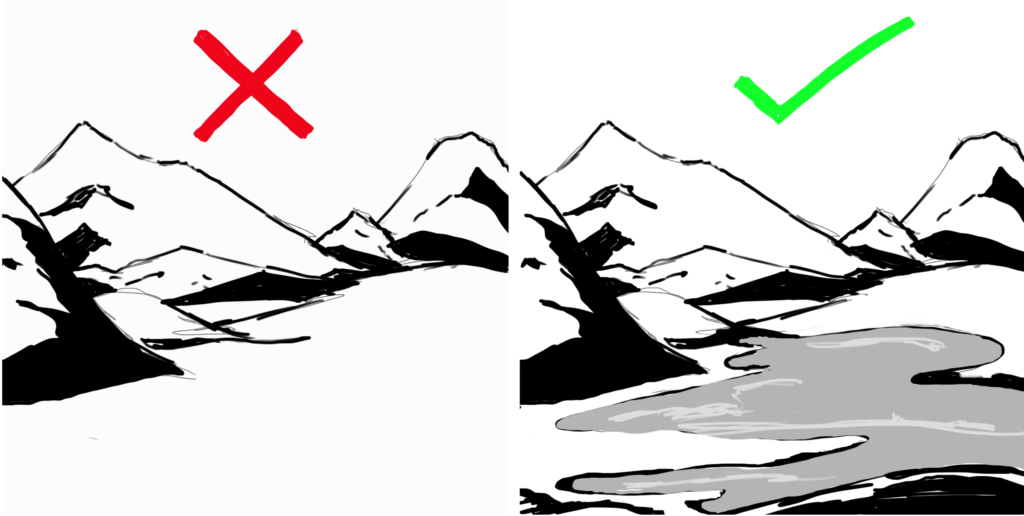
The side by side tip for drawing backgrounds is to use some elements in the background that can create depth.
Imagine you have created a landscape cartoon.
The whole scene is beautiful, the light is perfect only there is something that is making your artwork look flat or compressed.
It is due to the background!
Utilize some elements in the background that makes an artwork interesting.
For case, if there are mountains in a landscape painting, you lot can add together a lake.
This will definitely give depth to your photos.
What you have learned: Ever try to employ some elements in the background that can create depth and can make the artwork appealing to the optics.
Draw a background that can add to the quality of the scene | a tonal background
Always draw an appealing background to add to the quality of the whole scene.
For example, in the case of a landscape painting, yous can describe different trees in the groundwork that may enhance the whole flick.
You can also create an illusion of a blurry mural. Information technology tin can also heighten your painting.
What yous have learned: An artist must e'er utilize such a background that can to the quality of the scene.
Add together shadows and highlights
If you are drawing backgrounds of anime films, you should apply colorful backgrounds.
Plus, information technology is amend to add shadows and highlights in the backgrounds using unlike techniques and so that an illusion of depth tin can exist created.
What you accept learned: Adding shadows and highlights in the background is a expert technique for creating an illusion of depth.
Use unlike shades of colors in the background
Most artists prefer to use the white paper for their drawings but they desire a colored groundwork at the aforementioned time.
In such a case, using dissimilar shades of colors in the background is an ideal selection.
Information technology is a great technique by which you tin can depict backgrounds similar a pro.
What you have learned: Instead of adding different colors, you tin can add different shades of the same colour in the groundwork.
Determination
And then, these are the top x tips for drawing backgrounds.
It is besides important to make the backgrounds as elementary every bit you can so that the viewer can focus on the main object that you have drawn in your painting.
The colors used in the epitome must also correspond with that of the background.
So, if you lot want to draw backgrounds similar a pro, follow all the above-mentioned tips, have fun and happy drawing.
Practise you lot know any other technique for drawing the backgrounds in artworks?
Tell us in the comments section!
Other Featured Topics to Help Y'all with Cartoon
- Avoid These Things to Better Your Artistic Drawing
- The Ultimate List of Skills You lot Need to Begin Cartoon
- viii Means to Observe Cartoon Inspiration That Will Make Drawing Easy
- Over lxxx Sketchbook Ideas to Brand Your Drawings Interesting
- 10 Tips for Cartoon People for Beginners

Source: https://jaejohns.com/drawing-backgrounds/
Posted by: stanleygrou1963.blogspot.com
0 Response to "How To Draw Backgrounds Step By Step"
Post a Comment