

Why Is Drawing Such An Effective Tool When Discussing An Artist's Creative Process?
10 tips for writing an effective introduction to original research papers

After the championship and abstract, the introduction is the next affair your audience volition read, so it's vital to begin strongly. The introduction is your opportunity to bear witness readers and reviewers why your research topic is worth reading most and why your newspaper warrants their attending.
The introduction serves multiple purposes. Information technology presents the background to your study, introduces your topic and aims, and gives an overview of the paper. A skillful introduction will provide a solid foundation and encourage readers to go on on to the master parts of your paper—the methods, results, and discussion.
In this article, we present 10 tips for writing an effective introduction. These tips utilize primarily to total papers and letters reporting original inquiry results. Although some tips will be more than suited to papers in certain fields, the points are broadly applicative.
one. Kickoff broadly so narrow downwards
In the beginning paragraph, briefly draw the broad research area and so narrow down to your detail focus. This will help position your enquiry topic within the broader field, making the piece of work accessible to a broader audience, not but to specialists in your field.
two. Country the aims and importance
Papers rejected for "not showing the importance of the topic" or "defective articulate motivation" usually neglect this point. Say what you want to achieve and why your reader should be interested in finding out whether you achieve information technology. The basic structure tin be as simple equally "We aim to exercise X, which is important because information technology volition lead to Y."
three. Cite thoroughly merely not excessively
Instead of only maxim that the topic is important, show why the topic is important.
Once y'all've narrowed your focus to the specific topic of your study, you should thoroughly encompass the virtually recent and well-nigh relevant literature pertaining to your study. Your review of the literature should exist consummate, but not overly long—remember, you're not writing a review commodity. If y'all find that your introduction is too long or alluvion with citations, one possible solution is to cite review articles, rather than all the individual articles that have already been summarized in the review.
4. Avoid giving too many citations for one bespeak
Consider the following judgement: "Many studies take found a significant clan betwixt X and Y [4-15]." This judgement cites too many studies at in one case. Although references [4-15] might provide a good overview of the topic, this sentence doesn't provide enough context or explanation for these past studies. If all of these references are worth citing, they should exist discussed in greater specificity. For example, "A pregnant association has been institute between Ten and Y in men [4-7], women [viii-11], and children [12-15]."
`
5. Conspicuously state either your hypothesis or enquiry question
For enquiry in empirical sciences, stating a hypothesis can be an effective way of framing the inquiry. For instance, instead of stating "In this report, we show that 10 is related to Y by method A," you could say, "In this study, we hypothesize that X is related to Y, and we use method A to exam this hypothesis." For inquiry in formal sciences or exploratory inquiry, you could consider stating a research question instead: "In this study, nosotros examine the following research question: Is X related to Y?" Note that the enquiry question doesn't ever take to be stated in the interrogative form (with a question mark); instead, yous tin put the question into a declarative sentence: "In this study, we investigate whether X is related to Y." Hypotheses and enquiry questions are effective because they help give shape to the paper and serve as "signpost phrases" that guide readers through your paper smoothly.
6. Consider giving an overview of the newspaper
Example structure of an introduction
Introductory paragraph:
- Give a general introduction to the topic for broad audition
- Narrow the focus to your item topic
- State your inquiry trouble and aims
Literature review (usually several paragraphs):
- Summarize the relevant literature on your topic
- Describe the current state of the art
- Note any gaps in the literature that your written report will address
Research targets (usually 1 paragraph):
- State your hypothesis or inquiry question
- Briefly describe how y'all volition accomplish your aims
- Give a preview of your main results and country the contribution of the work (optional)
Paper overview (optional; one paragraph):
- Give a section-past-section overview of the paper'south contents
An organizational overview is more common in some fields than others. Information technology is specially common in technology, simply less so in medicine. In the last paragraph of your introduction, consider giving a department-past-department overview of your paper if it is appropriate for your field. For case, "In Department II, nosotros draw our assay methods and the datasets we used. In Department III nosotros present the results. In Section IV, nosotros discuss the results and compare our findings with those in the literature. In Department V, we state our conclusions and suggest possible topics for future research."
7. Go on it curt
Try to avoid an overly long introduction. A proficient target is 500 to 1000 words, although checking the journal's guidelines and past bug will provide the clearest guidance.
eight. Show, don't tell
One goal of the introduction is explaining why your enquiry topic is worthy of study. One of the most common pitfalls is to merely say, "Subject 10 is important." Instead of just proverb that the topic is important, show why the topic is of import. For example, instead of writing "The development of new materials is of import for the automotive industry," y'all could write, "The development of new materials is necessary for the automotive industry to produce stronger, lighter vehicles, which will amend safety and fuel economy."
9. Don't bury your readers in detail
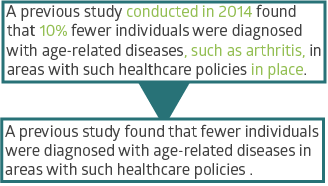
In the introduction, if your paper is in a field that commonly summarizes the study's principal results before starting the methods, you should avoid stating too many detailed results because these results demand the development in the other sections of your newspaper to exist properly understood. Instead of saying "We find that our algorithm requires 55% of the retentiveness and 45% of the ciphering time of the conventional algorithm," it is usually meliorate to give a general overview of the findings in the introduction: "Here we compare the proposed algorithm with a conventional algorithm in terms of memory employ and computational speed, showing that the proposed algorithm is both smaller and faster." Some older style guides suggest holding back the main result to build suspense, but now journals in many fields—medicine being a notable exception—encourage giving a preview of your primary results in the introduction.
10. Cheque the periodical requirements
Many journals accept specific requirements for the introduction in their guidelines for authors. For example, in that location might be a maximum discussion count stated or the guidelines might require specific content, such as a hypothesis statement or a summary of your main results.
Concluding remarks
I would like to shut with one last piece of advice: When y'all begin drafting a paper, the introduction should exist one of the get-go things you plan. The introduction serves as the roadmap for your paper; by clearly stating the study'due south background, aims, and hypothesis/research question, the introduction tin can guide you as yous write the rest of the paper. It's such an of import section—setting the scene for everything that follows—that many authors write the methods, results, and discussion sections in full before completing the introduction.
I hope these tips help yous to write effective introductions that capture the attention of readers and reviewers. If you're interested in more than writing tips, check out our 10 Tips for Writing an Effective Abstract. Also, through our EditingPLUS service, you tin can become writing tips and communication well-nigh your specific manuscript from a specialist editor.
Stay up to engagement
Our monthly newsletter offers valuable tips on writing and presenting your research well-nigh effectively, as well every bit communication on fugitive or resolving common bug that authors face.

Do you have a question almost academic writing or publishing?
Our online Q&A back up service offers researchers, physicians, and academics quick and easy online admission to specialist editors.
Enquire questions and receive the answers in English language or Japanese.

Source: https://thinkscience.co.jp/en/articles/effective-introductions-to-original-research
Posted by: stanleygrou1963.blogspot.com
0 Response to "Why Is Drawing Such An Effective Tool When Discussing An Artist's Creative Process?"
Post a Comment